
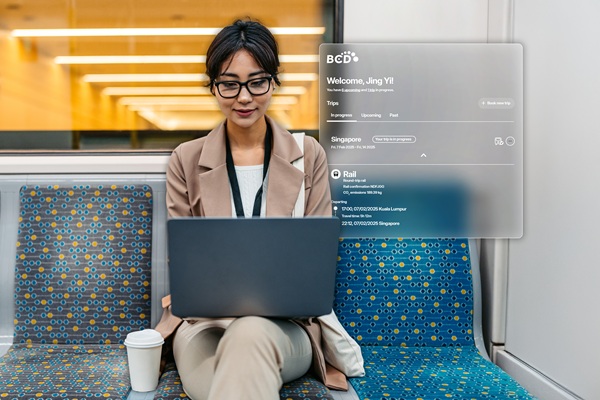
The moments that shape a business traveler’s experience rarely happen while booking a trip. They happen on the road, between airport security and hotel check-in, when plans change, questions arise and travelers need timely guidance. For travel managers, these moments matter because traveler satisfaction and program adoption are closely connected.
Through Tripsource, BCD Travel aims to make business traveler experiences easier by delivering the right information, support and recommendations at the right time. We sat down with Stephanie DeNote, Senior Vice President of Travel Experience & Commerce, to discuss the evolution of the corporate traveler experience and how business travel technology can benefit both travelers and travel programs.

What do business travelers expect from business travel technology?
Business travelers expect simplicity and personalization, and to use corporate travel technology to help decrease friction points throughout their journey. As we identify the priority moments that are most impactful in the traveler journey, we have learned that some of the hardest moments occur between the airport security line at their originating airport and their actual hotel at their destination. Tripsource is designed to provide guidance during these priority moments, helping reduce stressful moments throughout the end-to-end business traveler experience.
How is self-service changing the business traveler experience?
Today, travelers want connected experiences across booking, trip management, service and engagement. A connected travel experience, housed inside a self-service digital tool, can drive better outcomes, including adoption, travel program compliance and program performance.
Tripsource is a business travel platform where travelers and planners can book and manage travel. It provides end-to-end booking management, combines travel content from multiple sources, including aggregators and global distribution systems (GDS), and unifies it all within the platform. A company’s core travel policies can be applied to the customer experience along the travel journey and even post-trip—for example, when invoices are available for the customer to view.
Modern business travel technology should reduce friction by giving travelers the right information, guidance and support at the moment they need it.
How can better traveler experiences improve travel program performance?
A traveler’s experience should be curated and based on relevant traveler preferences. Tripsource’s guided engagement is not about overloading the traveler with more information; rather, it’s about empowering the traveler to make better decisions.
The challenge that corporate buyers face revolves around a longstanding friction point: if they have unhappy travelers, inevitably they will experience travel program leakage. Thus, compliance needs to be focused on guidance, not governance.
For travel managers, the user experience should be fluid, and a traveler’s choices should be easily visible to them. A smoother digital traveler experience can also support travel program adoption, policy compliance and overall program performance.
Travel managers:
- Travel managers can use Tripsource Insights to evaluate risks, with detailed reports available at their fingertips. This gives travel managers access to travel program analytics and risk information that can support decision-making and traveler oversight.
Travelers:
- While information on risks is included, it comes with contextualization. Thus, travelers are not overwhelmed with massive amounts of destination intelligence. Instead, destination intelligence can provide relevant travel risk information and context based on the traveler’s journey, destination and circumstances.
- Travelers also know that if they face any problems, support is readily available inside the platform. That combination of self-service and accessible traveler support can help reduce friction when travelers need assistance.
What is guided engagement in business travel?
Guided engagement uses traveler preferences, trip context and real-time information to provide relevant guidance at the moments when travelers need it. It’s not about sending more messages to the traveler. It’s about delivering personalized, contextual information that can help travelers make decisions throughout the journey.
How does Tripsource support travel managers as well as travelers?
Before GBTA this year, we redesigned the end-to-end experience, which focused on how to accelerate the intuitive guidance and contextualized cues provided to the traveler. At every stage of travel, we want users to feel confident in their decisions, so we positioned the guidance in a behavioral context.
For example, for a passenger who has just landed, the platform may alert them to their baggage claim carousel. For the traveler who is on the way to their hotel, directions and ground transportation options may be cued. If thunderstorms are imminent, Tripsource may provide guidance on weather conditions. These real-time, contextual cues are designed to help travelers navigate common friction points as they move through their journey.
We are constantly measuring satisfaction and listening to the detractors, and we are proud to say that we have a 90% satisfaction rate with Tripsource so far.
Why this matters
- Traveler expectations have changed. Business travelers increasingly expect the same intuitive, connected digital experiences they enjoy as consumers, making traveler experience a key driver of satisfaction and program adoption.
- Guidance beats governance. Providing relevant, personalized information at the right moment can help travelers make better decisions, reducing friction while encouraging compliance with travel program goals.
- Visibility benefits everyone. The ability to connect traveler behavior, travel program performance, risk and compliance data gives travel managers the insights they need to improve the traveler experience and optimize their programs.
- Flexibility is becoming essential. As travel technology ecosystems grow more complex, organizations need interoperable solutions that can integrate with a range of booking tools, platforms and partners.
How does an open travel ecosystem benefit corporate travel programs?
We know that flexibility and open systems are defining the future of business travel. We should not be seeking a one-size-fits-all solution but rather investing in the proprietary technology that is of value to our customers.
Tripsource fits within an open ecosystem philosophy. If clients want to use a different booking solution or different partners, they can. Industries such as life sciences or entertainment often have unique travel needs. Our offerings have capabilities from Tripsource but also give us the ability to build connectivity and interoperability with other trusted travel technology vendors and partners.
An open travel technology ecosystem can give organizations greater flexibility to connect different booking solutions, technology platforms and travel partners rather than relying on a single, one-size-fits-all system. This approach supports interoperability and connectivity across the broader corporate travel technology ecosystem while allowing clients to choose the solutions that best fit their needs.
By providing simpler booking and trip management, personalized information, contextual guidance and timely support throughout the traveler journey. Real-time travel information and proactive guidance can also help reduce friction when plans change or travelers need assistance.
A smoother traveler experience can make it easier for employees to use the preferred corporate travel program, while giving travel managers better visibility into traveler behavior, compliance and program performance. Reducing friction and making the preferred program easier to use can support greater adoption and help address travel program leakage.
Travel managers may consider capabilities such as booking and trip management, traveler self-service, policy integration, reporting, risk visibility, traveler support, personalization and integration with other travel technologies. Real-time traveler information, contextual guidance, travel program analytics and interoperability with other technology platforms can also support a more connected corporate travel program.